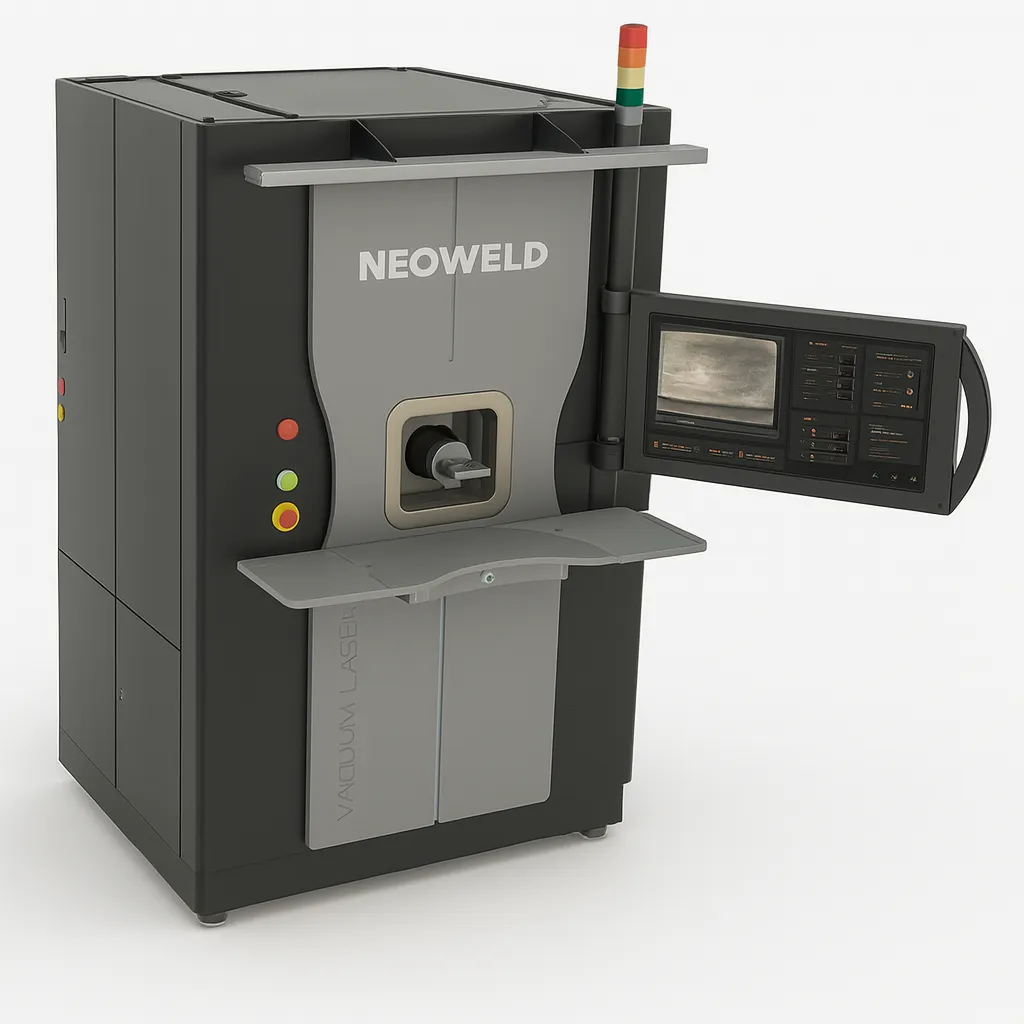
Vacuum laser welding is a joining process in which the part is placed in a chamber with a controlled environment and welded by a laser beam. The objective is straightforward: control the environment around the weld pool to produce a consistent, clean and repeatable weld bead.
This technology is particularly relevant for parts where joint integrity is critical: technical components, materials sensitive to oxidation, sealed assemblies, or production requiring rigorous traceability. It is not a universal solution; it must be qualified for the parts, materials and requirements of each project.
How does vacuum laser welding work?
The principle of laser welding remains the same: a highly concentrated beam provides the energy required to melt the edges being joined locally. In deep-penetration regimes, this beam forms a narrow cavity in the liquid metal, often called a keyhole.
The difference is that the operation takes place in a chamber under vacuum or reduced pressure. Before the welding cycle, the parts are positioned and the chamber is evacuated. The laser then makes the joint using a defined programme: power, speed, trajectory, focal position and vacuum level are adapted to the application. After cooling, the result is inspected according to the applicable quality plan.
Vacuum reduces the influence of ambient air and the metal-vapour plume on the interaction between the laser and the part. It can also change weld-pool dynamics and keyhole stability. This process control, rather than the word “vacuum” alone, determines the final quality.
Why use a vacuum chamber?
Reducing gas-related defects
In deep-penetration welding, keyhole instability and weld-pool dynamics can promote porosity. Research shows that reduced pressure can stabilise these phenomena and reduce porosity defects in some configurations. Results nevertheless depend strongly on the alloy, joint geometry and process settings.
For critical parts, this matters: porosity can reduce the local load-bearing section and become a sensitive point under repeated loading. Vacuum laser welding is therefore particularly relevant when consistency and joint reliability matter more than cycle speed alone.
Limiting oxidation and surface contamination
The presence of oxygen around the weld pool can affect the surface and metallurgy of the joint. Working in a chamber with a controlled environment reduces this exposure. This benefit should be considered carefully for materials and applications that are sensitive to it, including certain aluminium, titanium, stainless-steel and nickel alloys.
However, vacuum does not replace appropriate surface preparation. It does not remove the need to clean parts, control joint gaps or qualify welding parameters.
Controlling penetration and weld-bead geometry
At reduced pressure, the metal-vapour plume and weld-pool behaviour change. Depending on the material and parameter window, this may promote deeper penetration or a different weld-bead geometry. One study on a magnesium alloy, for example, observed better penetration and less porosity at a given reduced pressure, while also showing that a higher vacuum did not necessarily improve the result.
This is essential: the vacuum level is a process parameter. It must be selected through trials and qualification, just like laser power, speed and focal position.
Industrial applications
Vacuum laser welding can be considered when a joint must meet high requirements for quality, repeatability or leak-tightness. It is particularly suitable for:
- precision parts and small- to medium-sized components;
- assemblies of materials sensitive to oxidation or porosity;
- prototypes and series requiring metallurgical validation;
- parts for which parameter traceability is important;
- joints exposed to demanding mechanical or thermal loads.
In an industrial installation, performance is not limited to the laser. Part positioning, fixture design, the vacuum cycle, the operator interface, parameter collection and inspection methods all contribute to a robust outcome.
Limitations to consider
Creating vacuum requires a cycle time and a chamber suited to the size of the parts. The process also requires precise fixtures and clean parts. Depending on production needs, the expected quality gain must therefore be assessed against throughput, investment and handling constraints.
A sound approach always begins with a feasibility study: analyse the materials and joint, run representative trials, define acceptance criteria, then validate the parameters. This determines whether vacuum laser welding is the right choice and establishes a repeatable operating window.
Key takeaways
Vacuum laser welding combines laser precision with a controlled welding environment. It can help reduce gas- and oxidation-related defects when the process is properly designed and qualified. For a critical part, the right question is not only “can it be welded?”, but “can the required quality be obtained in a measurable and repeatable way?”
To assess your application, contact the Neoweld team.
Sources and references
- Mitigation of porosity defects in fiber laser welding under low vacuum, Journal of Materials Processing Technology, 2020.
- Vacuum laser beam welding of AZ31 magnesium alloy: Weld formability, microstructure and mechanical properties, Optics & Laser Technology, 2024.
- Numerical simulation analysis of pore suppression behavior in vacuum laser lap welding of Ta10W alloy, Optics & Laser Technology, 2024.